


Students' physical development is a major concern for both parents and schools. Traditional paper-based records and manual weighing methods are inefficient, prone to errors, and make data tracking difficult. A height and weight scale is now transforming this situation.
1. Long-standing challenges in campus health management
Schools conduct physical examinations every semester, with height and weight being mandatory checks. However, traditional practices have clear shortcomings:
● Manual weighing readings and paper-based recording are inefficient and prone to errors
● Data is scattered across paper forms, making it impossible to form a continuous growth curve.
Parents can only view the current data and cannot understand their child's developmental trends.
● Issues such as obesity, short stature, and delayed development are difficult to detect and intervene in early stages.
The core of these issues is the lack of a height and weight scale capable of precise data collection and automatic archiving.
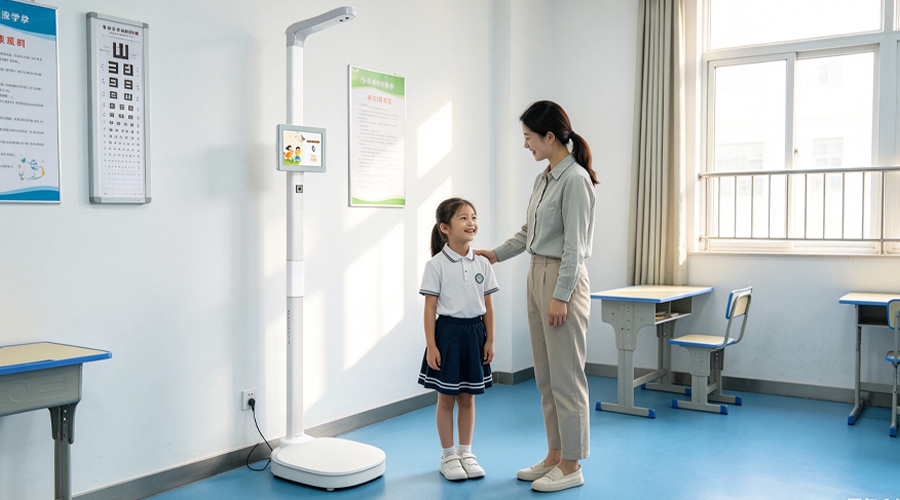
II. Core Advantages of the Height and Weight Scale
The height and weight scale is specially designed for campus scenarios and has the following advantages:
● Precise Measurement: It uses ultrasonic height measurement and high-precision sensor weighing, with extremely small errors. The data is collected in 3 seconds.
● Automatic Data Entry: Once a student stands on the height and weight scale, their identity is automatically recognized, and the data is uploaded to the cloud platform in real time, without the need for manual intervention.
● Growth Curve: The height and weight scale automatically draws the trend charts of each student's height and weight changes, making it easy to understand.
● Abnormal Warning: The height and weight scale can automatically identify students whose BMI deviates from the normal range, and promptly alert the school doctor and parents.
From "paper and pen record" to "automatic data collection", the height and weight scale has enabled a qualitative leap in campus health management.
III. Three Major Application Scenarios of the Height and Weight Scale
【Daily Physical Fitness Monitoring】Before the physical education class, students stand on the height and weight scale and complete the data collection within 3 seconds. The data is updated in real time. Over the course of a semester, the height and weight scale can accumulate hundreds of data points, far exceeding the traditional "once a year" frequency.
【Semester Health Screening】At the beginning and end of each semester, the height and weight scales uniformly collect data from all students in the school, automatically generating physical fitness reports for each class and grade. The school doctor can export the data as needed without the need for manual statistics.
【School-Parent Cooperation】The data collected by the height and weight scale is synchronized to the parents' mobile phones. Parents can check the trend of their children's height and weight changes at any time, and the school and parents can jointly monitor the growth process.
IV. Proposed Introduction
● Selection: Choose a height and weight scale specifically designed for students, with a measurement range covering the age groups from primary school to high school.
● Location: It is recommended to place it at the entrance of the sports room or the medical room, making it easily accessible for students at any time.
● Policy: Incorporate the collection of height and weight measurements into the regular routine of physical education classes to ensure the continuity of the data.
● Privacy: Ensure that the height and weight scale data is only accessible to the school doctor and parents, protecting the students' privacy.
Conclusion
A child's height and weight are not just numbers; they are signs of growth. The height and weight scale precisely records every centimeter of growth and leaves a trace of every kilogram of change. Introducing the height and weight scale is not merely about adding another piece of equipment; it is also adding a silent guardian "record keeper" to ensure the healthy growth of students.